WRIGLEY
After the Chicago Cubs won the World Series in 2016, there was a huge celebration at Wrigley Field. This brought back the moniker 'Wrigley' in a huge way, which belonged to William L. Wrigley Jr. who founded the company that bore his name more than 120 years ago in 1891.

Forming the company in 1891, Wrigley had $32 to his name and the idea of selling of selling soap called Wrigley's Scouring Soap. Had he limited himself to simply trying to sell the soap on its own merits, his story would have turned out very differently. Instead, he offered baking powder as a bonus to anyone who bought his soap. He found out that the baking powder was more popular than his Scouring Soap so he sold the powder instead.

Again, his story would be much different had he simply tried to sell the baking powder on its own merits. Instead, he offered two packages of chewing gum to anyone who bought a can of baking powder and discovered that the gum was more popular.

Figuring the third time's the charm, Wrigley decided to focus on chewing gum. Seen more as a product for women, he introduced new flavors such as Juicy Fruit and Spearmint to appeal to men and young people. This worked beyond anyone's expectations and, along with his innovative advertising, turned Wrigley into the largest manufacturer of chewing gum in the world.

His belief that everybody likes a free 'something extra' led him to discover that chewing gum was more popular than soap or baking powder. In 1907, he mortgaged everything to advertise his product in every way possible to tell people 'quick and often'. He sent chewing gum samples to everyone listed in U.S. phone books, a pioneering nation-wide direct mail venture. His son in the 1920's advertised Wrigley's Gum on radio programs and newspaper comic pages.By advertising everywhere and anywhere, he imprinted the words 'Wrigley gum' on the public's mind. Keep in mind that this was in the days before television and social media.
What are some of his lessons? Believe in yourself, even if you have only $32 to your name. Be flexible and ready to adapt if you discover that your original product isn't your most popular one. Realize that it's pretty well a given that there's no such thing as too much advertising. Plus, buying a baseball team and naming a stadium after yourself can pay dividends in the future!

STARBUCKS
Anyone who's been to Italy knows how much they love to sip their espresso at cafes, especially outdoors when the weather is nice. Howard Schultz, like many others, noticed how there was practically a coffee bar on every corner during a trip in the early 1980's.
 |
| The original Starbucks location |
Schultz was the Director of Marketing for Starbucks when he made this trip to Milan. He went back and tried to sell the owners of Starbucks on the idea of setting up cafes which would sell espressos and brewed specialty coffee. At the time, Starbucks sold coffee beans, tea and spices and only brewed coffee for samples. The owners weren't interested in the restaurant business but preferred having people making their purchases and leaving.
However, Schultz believed in his idea so much that they helped him out and eventually sold him the Starbucks name. The end result is well-known with Starbucks having over 23,000 locations in 67 countries, including 3,400 in China. The original owners are doing well with their company Peet's Coffee and Tea but obviously not quite as well as Starbucks.

As Howard Schultz was say, you must pour your heart into it if you want success. As he is quoted as saying, "When I first discovered in the early 1980s the Italian espresso bars in my trip to Italy, the vision was to re-create that for America - a third place that had not existed before. Starbucks recreated that in America in our own image; a place to go other than home or work. We also created an industry that did not exist: specialty coffee." He copied the success that he found in Italy by realizing that the same need existed in the United States. His success was due to his vision and hard work, the results of which can been seen everywhere today.
In an interesting twist, Howard Schultz announced on February 28, 2016 that Starbucks would open its first store in Milan in 2017!

As he states in his press release, “Now we’re going to try, with great humility and respect, to share what we’ve been doing and what we’ve learned through our first retail presence in Italy. Our first store will be designed with painstaking detail and great respect for the Italian people and coffee culture."
This is definitely the proper approach, as opposed to saying "We'll show the Italians how it's done!!". It's good to be driven when starting a business but it's better to also have humility and respect for others.
XEROX
Electrophotography is a mouthful when using a term to copy a document, and xerography isn't much better. However, asking someone to xerox a document is universally understood and can be attributed to Chester Carslon. Carlson invented the Xerox machine
which performed dry copying as opposed to wet copying as in a mimeograph machine. He persevered despite receiving 20 rejection letters by those who couldn't foresee how indispensable photocopying would become. One letter even asked "Who wants to copy a document on plain paper?".


He experienced years of rejection before the Haloid Company purchased his idea in 1944. From there, the first copier was sold in 1950 and Carlson went on to earn over $150 million in his lifetime.
Q-TIPS
Most everyone uses cotton swabs, or Q-Tips, to clean out their ears or other areas which require a delicate touch. They can also be used to clean items such as laptop keyboards.
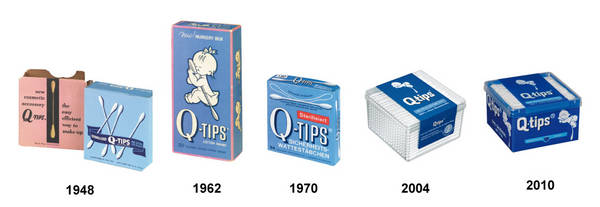
The original concept itself was simple enough - basically a toothpick with cotton attached to both ends. Leo Gerstenzang is said to have been inspired to produce the Q-Tip back in 1923 after observing his wife attaching cotton to the end of a toothpick to clean out her baby's ears. Since he was the owner of the "Gerstenzang Infant Novelty Company", he was able to construct a machine that made these cotton swabs. The product was first called 'Baby Gays', then 'Q-Tips Baby Gays' and then finally Q-Tips, the brand that became popular worldwide.
ebay
Founder Pierre Omidyar wasn't even 20 years old when he developed his Auctionweb site in his living room back in 1995, little knowing that it would turn into a multi-billion dollar online auction and sales site. It was a simply a hobby to sell some personal items, including a broken laser pointer that someone actually bought ("I'm a collector of broken laser pointers"). People were already buying and selling items through internet bulletin boards but Omidyar had the vision of a real marketplace where people could interact and make bids on items.

His side project kept growing so much that his ISP told him he had to upgrade his account due to the traffic. Instead of thinking it wasn't worth it, Omidyar pursued this avenue and started to charge people to use his site. When this met with little or no objection, the site grew exponentially to the ebay that we know today. The basic model was that people could explore the site for free but would be charged for listing and selling items. This model enabled the company to grow to a market value of nearly $30 billion in 2016.

A&W ROOT BEER
Roy Allen worked as a hotelier after World War 1 when he encountered an old soda fountain operator who convinced him to buy his root beer formula. Told that he could make a fortune selling 5-cent root beer with the formula, Allen took a chance and opened a root beer stand in Lodi, California in 1919.
 |
| The original A&W root beer stand |
Allen wasn't counting on blind luck to make his business venture succeed. Prohibition had come into effect and sales of alcohol were banned across the country. Allen believed that people would flock to a stand that resembled a Wild West saloon with a bar and even sawdust on the floor. It also helped that many customers felt that 'root beer' was close enough to 'beer' to enjoy on a hot summer day!
 |
| The closest thing to a mug of beer during Prohibition! |
A stand in Lodi did so well that Allen opened a second one in Stockton, California. He partnered with one of the employees, Frank Wright, and they named their company A&W in 1922. From there, the company grew nationwide and continues to be a success story to this day, all because Roy Allen took a chance on a formula for root beer.
Creating a business can be started through a stroke of inspiration but it does take hard work before true success can be attained. Still, the results are very often well worth it. If you think of an idea that might seem strange, follow through on it! The world can be yours.

My Twitter Page
My Pinterest Page

Travel Discounts!


